

Samudra Report No.85, May 2021

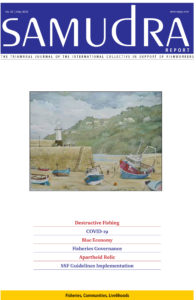
Contents
Notice
What is Destructive Fishing? ……………….. 4
An ongoing project attempts to define ‘destructive fishing’
Economy
Blue Gold …………………………………………. 7
100 companies generated 60 per cent of the revenues from the oceans in 2018
Turkey
Be Resilient, Not Vulnerable……………….. 10
COVID-19 highlights structural inequalities and power asymmetries in Istanbul
SSF
Too Big to Ignore……………………………… 14
On the Regional Small-Scale Fisheries Governance Training Course for Africa
Cambodia
Complex History, Hopeful Future………… 18
Community Fisheries in Cambodia thrive in inland and coastal settings
South Africa
The Relic of Apartheid……………………….. 22
How Indian-origin subsistence fishers in South Africa deal with COVID-19
Latin America
Baffling Shades of Blue …………………….. 28
The Blue Economy can easily become a new label to justify old injustices
Brazil
Woes Compounded…………………………… 32
A year after an oil spill, COVID-19 has worsened Brazil’s Discovery Coast
Tanzania
Buying into a Noble Idea …………………… 36
Tanzania is among the trailblazers in plans to implement the SSF Guidelines
Films
The Silences in…

TEN

A group of young activists sailing, ten years after the revolution, through one of the sea crossings used by irregular immigration boats, in a discussion about the most important issues they experienced closely the ten

Declaration of creation SouthernMediterranean Non-State Actors Platform in Fisheries and Aquaculture

Tunis August 20, 2019
• Considering the importance of the fisheriessector in the southernMediterranean countries and itseconomic and social role,
• Considering the efforts of international and regional structures supporting the participation of non-state actors in the formulation of decisions of particularinterest for the development of uniformpolicies and regulations for the sustainable management of the fisheries and aquaculture sector in developing countries; Member States of the African Union and the General Fisheries Commission for the Mediterranean;
• Considering the accession of Mauritanian non-state actors to the West African Platform during the workshop held in Lomé (Togo) from 19 to 21 September 2016,
• Considering the commonfeatures of the southernMediterranean, in particular the marine environment,
• Considering the non-participation of non-state actors in Egypt and Libya in anyregionalplatformdespitetheir importance in the fisheriessector of the African continent,
• Consideringthat the status of small-scalefishingremainsmarginalized and complains of numerousshortcomings and that the artisanal fishermanisstill operating underdifficult conditions,
• Considering the importance of dialogue, coordination and exchange of experiencesbetween non-state actors,
Following the subregional workshop to support professionalfishingorganizations in NorthAfricaorganized in Bizerte, Tunisia, from 24 to 26 September 2013, duringwhich the participants decided to create a fishingplatformincluding associations and professionalorganizations, weannounce the launch of the creation of a platform for non-state actors in fisheries and aquaculture in the southernMediterranean. This platformgenerallyaims to help theirmemberscontribute to the fightagainstpoverty and foodsecuritythrough the sustainabledevelopment of fisheries and aquaculture in the region. In particular, itaimsto:
- Support fisheries and aquaculture stakeholders in SouthernMediterranean countries to ensure the effective implementation of the fisheries and aquaculture reformpolicyframework and strategy at local, national level and regional;
- Ensure the principles of participatorygovernance of the fisheries and aquaculture sector and coherence and sustainability of policies and interventions to ensurefoodsecurity and sustainablelivelihoods for differentactors;
- Providespace for coordination and pooling of non-state actors’ efforts to buildsolidarity, shareknowledge and experiences, and developregionalinitiatives;
- Contribute to the dissemination of good practices and innovations, as well as the evaluation and dissemination of researchresults;
- Promote initiatives for transparency, the ecosystemapproach and precautionaryprinciples in the fisheries and aquaculture sector;
- Improving the governance and technicalcapacity building of non-state actors in areas related to the development of fisheries and aquaculture in their countries
- Exchange of information on experiences and challenges arisingfrom the exploitation of sovereignfisheries;
- seekfinancial and technicalresources for the properfunctioning and sustainability of thisplatform and establish and activate action plans;
- Work and cooperatewith international and regionalorganizationssupporting the organization of the profession and thosefacilitatingtheir participation in the formulation of decisions at the international levelwith a view to rationalizing the exploitation of fisheryresources;
The founders of the platformagreed to facilitate and encourage the integration of variousprofessional and non-state organizations active in the fisheriessector in the southernMediterranean countries with the creation of two offices (an office for non-state actors in NorthAfrica and a second for southernMediterranean countries located on other continents).
A provisionalexecutive office has been created to prepare the draftstatutes, the internalregulations and the action plan for the nextperiod.
Contact us : southmedfish@gmail.com
Tunisian fishermen have become accidental migrant rescuers

By Leslie Carretero Published on : 2021/11/15
In the south of Tunisia, fishermen regularly rescue boats full of migrants that are in distress. For them, coming across an overloaded boat has become part of their daily “routine”, just like finding dead bodies floating in the water.
Slah Eddine Mcharek is sitting on the terrace of a café in Zarzis, a small coastal town in southern Tunisia. The 53-year-old fisherman is having a morning coffee after a night spent at sea. This time, his night was just occupied with finding fish. For several days, the sea has been rough and migrants have not risked trying to cross the Mediterranean in frail boats.
Mcharek started fishing when he was 15 years old. In recent years, his sea trips have taken a different turn. Migrant boats regularly cross his path. Rescuing exiles from neighboring Libya or the Tunisian coast has become “a routine”, in his words, as he speaks with InfoMigrants.
Read more: Migrants find themselves ‘trapped’ in Tunisia, a country that can offer them nothing
In the port of Zarzis, all the fishermen say they often come across migrants at sea. “Foreigners? We see them every time we take our boats out,” says one of them. “Look at this ship, there were more than a hundred people in it,” said the man in his fifties, pointing to an imposing boat moored in the port.
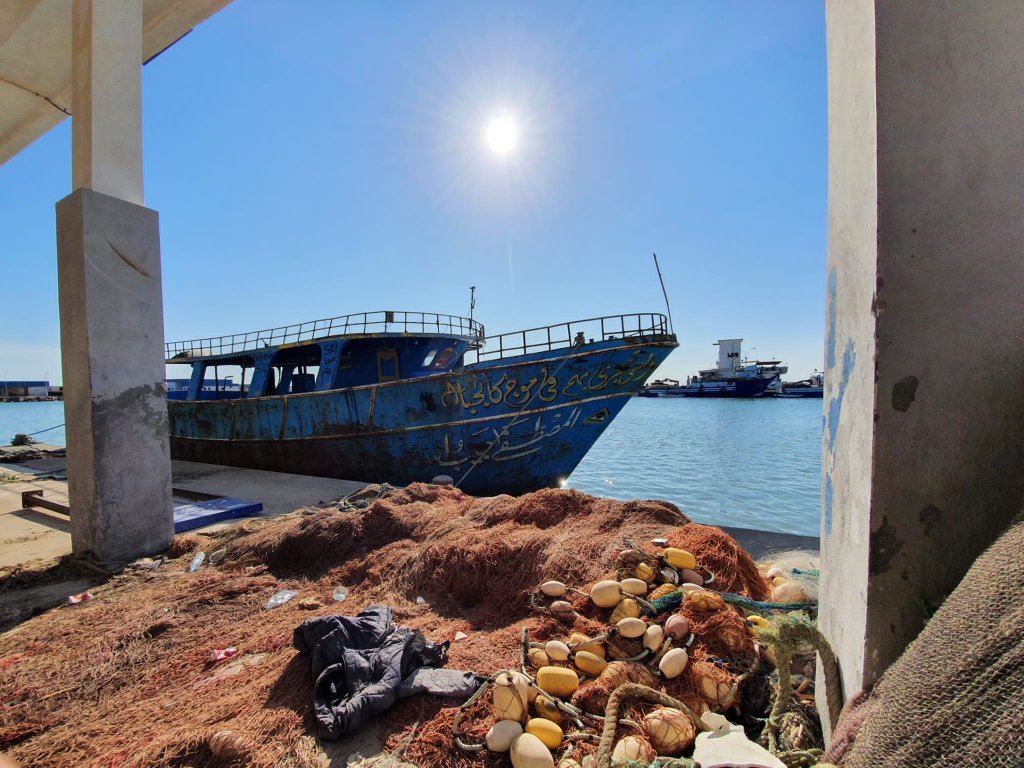
From his regular cafe in downtown Zarzis, Mcharek explains that the number of “overcrowded” craft keeps increasing. “We have seen them since the early 2000s but the number has been growing in recent years. I can’t even begin to calculate the number of boats I have seen over the years, there are just too many.”.
Pressure from the Libyan coast guard
When the fishermen encounter a group of migrants in difficulty in the water, they alert the Tunisian authorities. The latter proceed with the rescue if a coast guard vessel is nearby. If not, it is up to the fishermen to assist the migrants. Some have been trained in sea rescue by Doctors Without Borders (MSF) to avoid tragedies and ensure the safety of the shipwrecked.
Read more: Zarzis, Tunisia: Overwhelmed by the unclaimed bodies of migrants
MSF did not prepare the fishermen for confrontations with the Libyan coast guard however. Tunisian authorities allow their Libyan counterparts to enter their waters to intercept migrant boats. Since a 2016 agreement with the European Union, Tripoli has been responsible for part of the search and rescue zone (SAR zone) near its coast. This has caused huge upset for Tunisian fishermen, who say they receive constant pressure from “Libyan militias.”
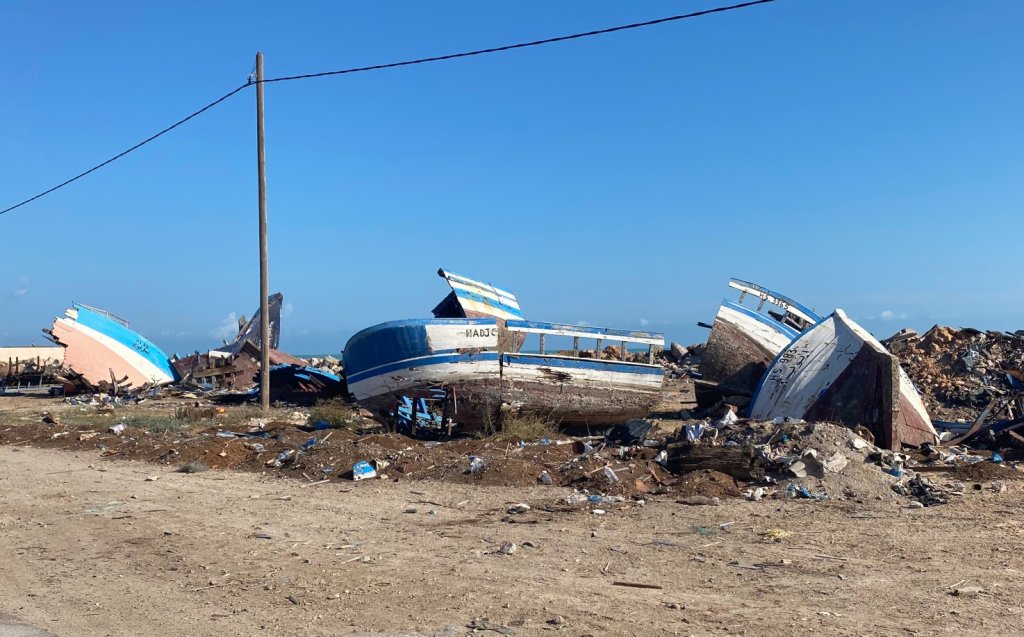
“They are armed and often fire in the direction of the exiles’ boats to prevent them from continuing their journey. Sometimes they also fire towards our boats,” says Mcharek. “Every time we see Libyans near the migrants, there is shooting,” adds Chamesddine Bourassine, another fisherman from Zarzis. “We have no weapons. We can’t defend ourselves against these lawless militias.”
‘We can’t let people die in front of our eyes’
Confrontations with Libyans at sea are not their only source of anxiety. The criminalization of rescue operations also worries the fishermen, who fear prosecution. “My colleagues are afraid to rescue migrants, because they fear being accused of playing the role of smugglers,” reports Mcharek.
In late 2018, six Zarzis fishermen were prosecuted for rescuing exiles off Lampedusa and towing them to the Italian island. They were finally released. But the case has left its mark on people’s memories.
Bourassine was one of the accused. Despite this negative experience, he continues to help migrants in distress. His last rescue was in early October. “We can’t let people die in front of our eyes. We don’t gain anything by doing this, it’s simply humanity,” he insists.
The Tunisians juggle as best they can between rescues, threats from neighboring coastguards, and their industry, which has become less profitable as the number of rescues at sea increases.
In addition to the loss of income, there is the trauma. Coming across a dead body floating in the water has also become part of their daily life. With the currents, many bodies from Libyan waters drift off Tunisia and wash up on the beaches of the south of the country. Some are swollen with water or in an advanced state of decomposition. “The smell hits you in the gut. It is indescribable. The worst thing is to see children,” says Mcharek, with a dark look in his eyes. “We will never forget, the images will remain forever with us.”
Leslie Carretero was reporting on location in Tunisia
Tunisia and FAO ink accord for agriculture and fisheries

TUNIS – Cooperation agreements for two projects have been signed in Tunis by Agriculture, Water Resources, and Fisheries Minister Mahmoud Elias Hamza and a representative for the UN Food and Agriculture Organisation in Tunisia, Philippe Ankers.
“These two new projects are part of the “Cooperation Framework 2021-2025 of the United Nations System,” the FAO said in a statement.
The first project is supported by the Green Climate Fund (GCF) and has the FAO as partner in its implementation. It aims to improve food security and resilience to climate change through drawing up a National Action Plan for the agricultural sector.
Different adaptation options related to water, land, crops, livestock, fisheries and forestry will be developed, the statement said.
This plan will focus on planning adaptation actions and clarifying the roles and contributions of stakeholders, including private sector partners. The expected results of this project are: strengthening knowledge on climate change adaptation for informed decision making; supporting the resilience of the agricultural sector through climate-smart investments and public-private partnerships; implementing social protection plans for better adaptation in the most vulnerable rural communities; and innovation through new digital technologies, the statement added.
The second project is supported by the Norwegian Agency for Development Cooperation and complements the activities previously carried out by FAO in partnership with the Tunisian government, to generate factual data on social protection in the fisheries and aquaculture sector.
In its “SocPro4Fish” component to be implemented in Tunisia, the project will focus on improving access to social protection and aims at strengthening Tunisian institutional capacities to extend coverage and improve the quality of social benefits targeting fishermen and workers in the fisheries and aquaculture sector.
Source : https://www.ansamed.info/ansamed/en/news/nations/tunisia/2021/12/28/tunisia-and-fao-ink-accord-for-agriculture-and-fisheries_d2a99b7a-2884-4ef0-b8c1-afd0cefaa936.html
